
Introduction
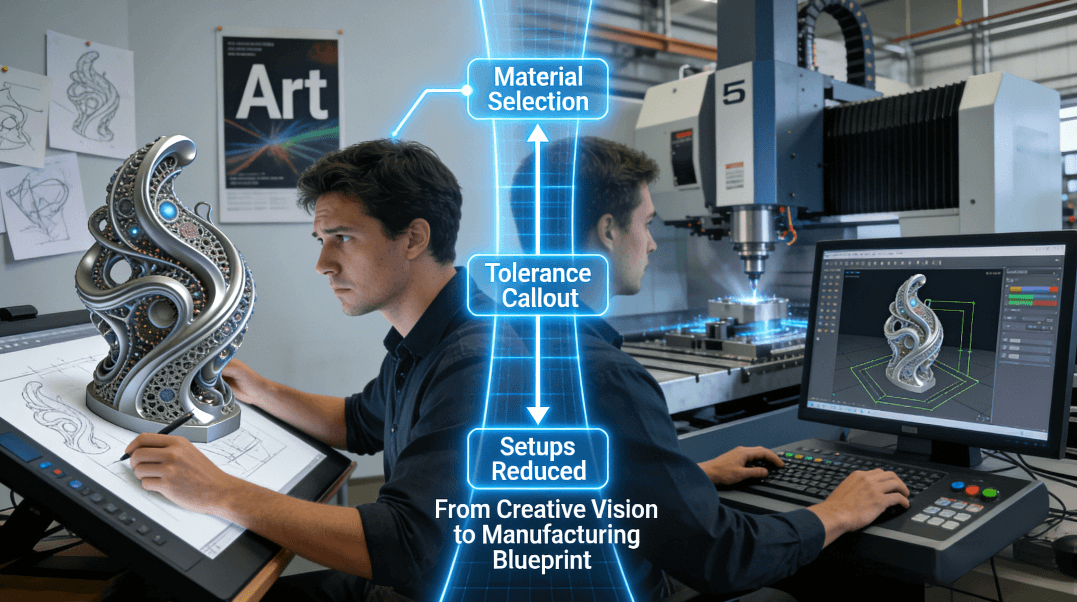
A common problem plagues designers, entrepreneurs, and engineers in their quest to bring a beautiful 3D model, perhaps even featuring a beautiful custom logo, into a physical product or prototype. The process is fraught with problems, from samples that don't quite match the vision, quotes that break the budget, and communication nightmares, to project delays that are catastrophic in their severity.
The problem lies in the knowledge gap between designers and manufacturers. While designers are masters at aesthetics and functionality, they may not be as knowledgeable about the impact of material properties, machining limitations, and tolerance calls on the overall cost and feasibility of a project. The procurement process in the manufacturing world is often a black box, and this article is designed to demystify the process of precision manufacturing, how 5-axis CNC machining works, and a clear understanding of costs and how to communicate effectively in order to bring a project together perfectly.
Why Do the Most Beautiful Designs Face the Greatest Challenges in Manufacturing?
The most beautiful and ambitious designs always seem to face the biggest challenges as they leave the digital world and enter the physical world. The features, such as organic and free-form surfaces, micro textures, and monocoque designs, pose significant problems to conventional 3-axis machines and manufacturing techniques in general. The conventional 3-axis machines, being restricted to linear movement, require multiple axes to be involved in creating complex parts, which in turn leads to significant errors, poor finishes, and in some cases, the part cannot be manufactured as one complete piece.
1. The Duality of Digital Freedom and Physical Constraints
The very tools enabling limitless creativity can paradoxically be the sources of confusion about a product's manufacturability. A perfect, watertight, and closed 3D surface is a mandatory feature to be able to make any part, but this is only the minimum condition and does not cover manufacturability at all. A wide gap exists between a perfect digital surface and the physical solution, whereby the material has to be removed, and this gap is bridged by the laws of physics, tool geometry, and machine kinematics. Designs that disregard this reality are bound to result in expensive redesigns, limitations in functionality, and/or manufacturing failure.
2. The Critical Need for a Digital-Physical Bridge
In order to achieve agility and quality in today’s production, there must be a free flow of data. As highlighted in the frameworks for smart manufacturing, the quality of data between design and the physical world is of paramount importance. However, this data is only as effective as the production technology’s capability to interpret and react to it. In complex geometries, 3-axis machining becomes a bottleneck, incapable of executing the complex instructions of an advanced design without compromising the intent or efficiency.
3. Setting the Stage for Advanced Solutions
As a result, executing sophisticated designs requires a technology of equal sophistication. The limitations of traditional technology create a critical need for a technology capable of executing complex toolpaths, maintaining a single reference point, and cutting complex features in a single operation. This fundamental knowledge is critical prior to discussing technology and its role in manufacturing complex geometries and preserving precision in creative design.
How Does 5-Axis CNC Machining Become the "Game Changer" for Complex Design Realization?
5-axis machining is a radical departure from traditional machining methods. Besides the conventional three linear axes, it has two rotational axes of movement. As a result, in a single setup, the cutting tool can be directed to approach the workpiece from any direction. To grasp the benefit of 5-axis machining, consider making a complex shape by carving it out of a solid block of material. You can think of a 5-axis machine as the sculptor's hand, while a 3-axis machine represents the hand being fixed at a particular position.
The Mechanics of Unrestricted Access: The main benefit of 5-axis machining is the unparalleled geometric freedom it offers. It is possible to rotate or tilt either the workpiece or the cutting tool at the same time through 5-axis machining, therefore workpiece can be machined without any collision. One can machine the whole workpiece as a single unit without the need to assemble different parts. Besides that, machining can be done more efficiently as shorter tools, which are stiffer and less prone to vibrations, can be utilized.
Eliminating Error at the Source: Eliminating mistakes at the source is however the greatest benefit. With 3-axis milling, errors may occur each time the part is moved to a new location. The 5-axis machining has one stable reference point only, and all operations are performed with reference to this point. Each and every operation is performed with reference to a single coordinate system. This leads to perfect alignment between holes, faces, and curved surfaces. This level of precision is what makes crafting with CNC technology so accurate.
The Foundation for Predictable and Accurate Costing: The reliability and speed of the 5-axis machining process form the basis of project cost predictability. In principle, this method is very efficient since all machining operations are done in one setup, and every cut is related to a single, unchanged datum point. This way, the process is free of cumulative errors, fixture variables, and dependencies of multi-step processes that are naturally a part of traditional machining and usually cause cost estimation uncertainties. So, knowing the workings of 5-axis CNC machining for making accurate quotes is a must. The underlying idea of the technologyfull, multi-sided machining in one fixturingleads to a manufacturing process that is stable, repeatable, and highly predictable. This, in turn, enables the making of quotes that are not only accurate but also reliably implemented from the first part to the last one.
Decoding the Manufacturing Quote: What Factors Truly Drive Your Part Cost?
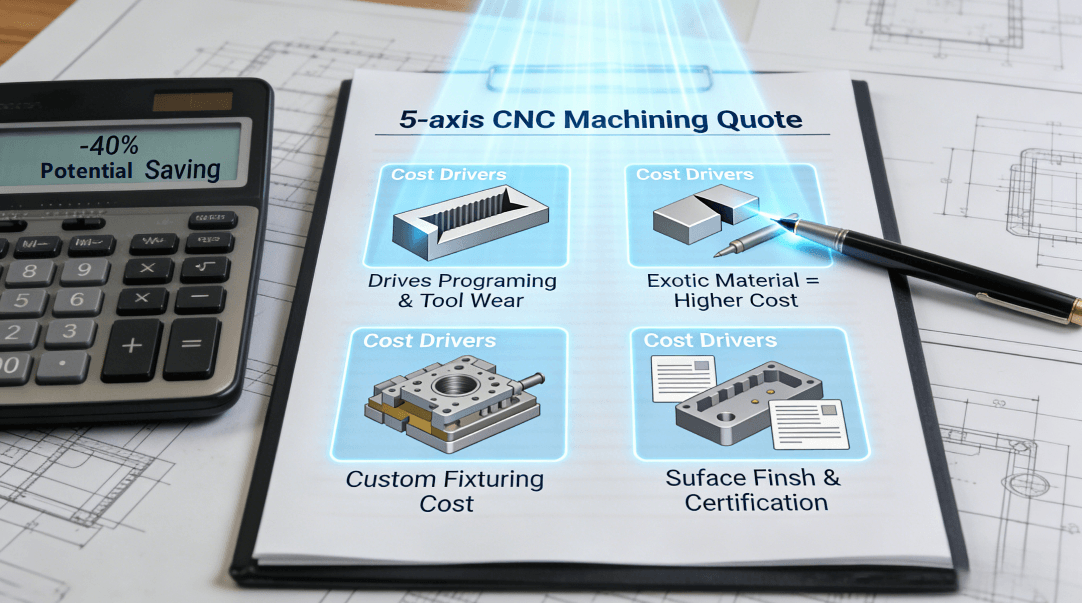
The manufacturing quote, as mentioned, is not a random figure. It is, rather, a highly detailed financial model of the manufacturing process. Understanding the composition of the figure allows the designer to make cost-efficient decisions from the outset. The key drivers of the cost of the 5-axis CNC machining part include: machine and programming time (as the more complex the part, the more complex the CAM programming required), material and tooling (as the more exotic the material, the more expensive it becomes, as well as the rapid tool wear required with more complex parts), custom workholding and fixturing (as the more unique the part, the more unique the workholding required), as well as Post-Processing and Quality Assurance (as the part may require processes such as anodizing).
1. The Hidden Cost of Complexity
Complexity is the largest cost driver. Parts with many internal corners, narrow slots, and compound curves require slower machining speeds and more sophisticated tooling and programming. Every avoided setup through the efficiency of 5-axis machining saves money. However, the programming required to achieve this ideal single-setup toolpath is also a legitimate cost appearing in the final quote. Transparency in this regard is necessary for an accurate 5-axis CNC machining quote.
2. Quality as an Investment, Not an Expense
Having a stringent quality system, while driving up the initial price quote, is a cost-saving investment in the long term. Processes that conform to standards like ISO 9001 provide traceability and ensure repeatability. This eliminates catastrophic expenses in case of batch failures, recalls, and damage to brand reputation. When asking for how to get a CNC machining quote, the willingness to discuss their inspection process (First Article Inspection Reports, Coordinate Measuring Machine results, etc.) is indicative of their maturity and should act as a success guardrail for your project.
3. Designing with Cost in Mind
With this new knowledge, designing with a focus on cost becomes our superpower. Art is still our priority while we are cost-conscious designers. In fact, we look at the two sides of the same coin of decisions and highlight how beneficial they can be if turned in to production-ready decisions. Minorly larger internal radii, easier-to-machine materials that still fulfill the functional requirements, as well as greatly relaxed tolerance criteria can lead to cutting down not only the machining cost but also lead time without changing part form, fit, or function. In short, this is how you accomplish very high precision in manufacturing by spending the right amount of money.
How to Identify a Manufacturing Partner Who Truly Understands Your Design Intent?
Working with a 5-axis CNC machining manufacturer, one that excels in the machining of complex parts and has industry certifications, is no longer just a procurement process but a strategic business move that helps direct your designs from conceptualization to successful mass production. Your right manufacturing partner should be like your own team member who, while working in sync with you, is also capable of bringing your ideas to life. Technical skills (get them to show you their portfolios with similar parts and complexities), communication style and willingness for partnership, quality qualifications and industry-specific certifications, and Operation transparency are some of the criteria for evaluation.
The Proof is in the Portfolio: The best indicator of how well a supplier will perform in the future is how well they've done in the past. Research supplier case studies for parts with similar complexity to your part. Check for examples of surface finish quality, attention to detail, and experience with your material of choice. A good supplier will be proud to share this with you, as it shows off their Engineering for Custom Creations skills!
Assessing Cultural and Systemic Fit: The key to the success of the partnership is shared values and processes. During the vetting stage, it is important to present a challenging part of your design. A true partner is one that asks insightful questions about its function and how it can be improved. It is important to assess their project management system. Do they have a single point of contact? How do they handle changes to the design? Their operating discipline is often evident in, and is enhanced by, their commitment to recognized quality management standards.
The Value of a Specialized Strategic Ally: That is why working with a manufacturer who is a specialist in producing complex parts and has a strong engineering culture is a whole other level of experience to the one where a manufacturer just sells a part to a customer. To the point where actually a manufacturer and a customer is like a value engineering partnership. Especially in the field of challenging projects such as automotive, aerospace, and medical equipment, where even minimal errors are unacceptable, a partner's holding the relevant field-specific certificates is essentially a genetic-therapy-protection-strategy.
From Concept to Market: What Are the Best Practices for Collaborating with a Manufacturing Expert?
Most product launch successes came from collaborative work between product designers and manufacturers that started early and deep. Treating a manufacturer not just as a production partner of the final product but involving the manufacturer as a consultant during the design phase is the right mindset. Giving the manufacturer full and clear technical data is what you should do actually. A very detailed 3D model (STEP/IGES) and 2D drawings with well-defined geometric dimensioning and tolerancing (GD&T), etc. are part of it. Each instruction from material certificates to the final looks should be clearly and precisely described without any room for doubt.
1. The Power of Early Engagement
Bringing manufacturing knowledge into the product development loop initially can generate a huge amount of benefits. A skilled engineer is capable of identifying potential manufacture-ability issues at a stage when changes are easy and low-cost in the 3D working model. In addition, they can recommend other features that may be developed to do the same job at a lower price and/or with greater reliability. Thus, this is the best way to "design in" cost reduction and faster launching benefits.
2. Speaking the Same Technical Language
For clear communication, we need to express ourselves in a language that is mutually understood. As a result, employing ASME Y14. 5 GD&T standard in your drawings will remove all the uncertainties. It accurately lays down the limits for form, orientation, and location variations so that the manufacturer is definitely aware of what is critical. Providing the manufacturer with the complete application context may even lead them to propose to you the changes in material or process that you did not consider.
3. Building a Partnership for the Long Haul
Think beyond the roles of supplier and customer and consider the idea of a strategic partnership. Share your entire product roadmap and business ambitions with the manufacturer. A manufacturer who truly cares about your success in the long run will hardly see a mere order delivery as their limit. They will desire to participate in talks on product enhancement, supply chain optimization, and production efficiency increase. Such a partnership level, centered on advanced manufacturing for designers, can transform the manufacturing process into one of our most significant competitive advantages sources. Besides, the team will support you from the stage of digital design to the physical part.
Conclusion
Turning a creative design into a final, tangible product is like a fusion of art and science. Understanding the capabilities of highly advanced manufacturing processes such as 5-axis CNC machining, along with the factors that really influence the costs of manufacturing, the designer can achieve an unprecedented level of control and cost-effectiveness. Success in this line of work relies heavily on continuous communication, sticking to design-for-manufacturability best practices, and partnering with a manufacturer who not only provides expertise and quality alignment with your vision, but also understands the market. Getting the collaborative effort right is what ultimately enables connecting the digital and physical worlds in a way that is both efficient and attractive.
FAQs
Q: For a low-volume prototype project, is it cost-effective to use 5-axis CNC machines?
A: You might reckon that it would be quite costly to operate 5-axis CNC machines considering the hourly cost of the machine however it should be consideredthat since this machine can carry out all operations in one setup, this could actually be quite the cost-effective option in the long run. Indeed, for prototype parts with complex designs, it may be more cost-effective to utilize this machine because it can enable production at a higher speed and accuracy in the initial stage..
Q: What is the most important information to provide when requesting a quote from a manufacturer?
A: All relevant information should be sent to the manufacturer in one package, which includes 1) a 3D model in STEP or IGES format, 2) 2D drawings that include critical tolerance and finish information, 3) material specifications, 4) required quantities, and 5) finishing or certification requirements.
Q: How can I ensure that the quality of small-batch production meets that of the prototype?
A: The right approach to ensure that the output of the production floor matches the prototype is by meticulous control of the process. Typically, a reliable manufacturer would perform a stringent first article inspection on the prototype. To have a control over the production, a manufacturer should apply statistical process control. It is also beneficial if the manufacturer operates under a Quality Management System like ISO 9001, as this provides a set of process controls to ensure consistency.
Q: What if, after finalizing the design, I realize I need to make a design change?
A: It is a question of timing when you decide to make a design change. If the change is done before programming or manufacturing of the parts, you will likely incur little to no cost. However, if you make a design change after production has started, there may be costs involved in scrapping or reworking. A DFM review by the manufacturer will assist you in avoiding last-minute design changes. Also, a reliable manufacturer will discuss with you openly about any costs related to design changes.
Q: What kinds of materials, besides metals, can 5-Axis CNC machines work with for creative projects?
A: 5-Axis CNC machines are quite flexible. In addition to metals, 5-Axis CNC machines work well with engineering plastics, composites, modeling materials, and woods. The material will affect the tooling, cutting parameters, and finished part characteristics. The material will also affect the cost. Be sure to talk with your manufacturer about the best material choice for your project.
Author Bio
The article is based on the knowledge and experience of manufacturing technology experts. The article attempts to fill the gap between the creative possibilities of design and the challenges of engineering. For design and innovation professionals looking to overcome the challenges associated with bringing a high-end design to market, a detailed consultation and feasibility study is suggested. LS Manufacturing is a precision manufacturing partner dedicated to helping you bring complex and intricate designs to life with high-end engineering and quality management practices.